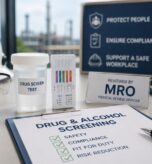
Drug and alcohol screening is one of those programmes every safety-conscious employer knows they should have, and almost every HR and HSE team quietly worries about getting wrong. Done casually, it creates more risk than it removes — mishandled results, disputed dismissals, and privacy complaints. Done properly, with a Medical Review Officer (MRO) overseeing the process, it becomes one of the more defensible parts of a safety programme rather than one of the shakiest. Here’s why it matters, and why the “who’s overseeing it” question deserves as much attention as the “are we doing it” question.
Why do drug and alcohol screening at all?
An employee under the influence of drugs or alcohol at work isn’t just an HR issue — it’s a live safety hazard, particularly in roles involving machinery, driving, working at height, or hazardous substances. Employers in Singapore carry a general duty under the Workplace Safety and Health Act to ensure the safety and health of employees, and an impaired worker undermines that duty regardless of how good the surrounding risk assessments are on paper. On top of the workplace safety angle, Singapore takes a firm, well-known zero-tolerance stance on drugs generally — under the Misuse of Drugs Act, consumption of a controlled drug is itself a criminal offence for citizens and permanent residents, even if the consumption happened overseas. That combination — safety exposure plus the seriousness with which drug use is treated nationally — is why screening programmes carry real weight here, well beyond a standard HR policy.
HR’s concerns — and how screening addresses them
- “Are we exposed if an impaired employee causes harm?” If an employer knew or should have known about impairment risk and didn’t act, that gap becomes a liability problem fast — both under WSH due-diligence obligations and in any subsequent claim. A structured screening programme is direct evidence the company took reasonable steps.
- “Will a positive result hold up if we have to act on it — including terminate?” Nothing is more damaging to HR’s credibility, and more likely to end up in a tribunal, than a dismissal based on a result that later turns out to be procedurally flawed or medically explainable. HR needs the underlying result to be defensible, not just convenient.
- “How do we handle this without breaching privacy obligations?” Drug and alcohol test results are sensitive personal data. Under Singapore’s PDPA, HR has to be careful about what’s collected, how it’s stored, and who sees it — a positive result mishandled internally (shared too widely, retained too long, or discussed loosely) is its own compliance problem, separate from the test itself.
- “What about legitimate medical explanations?” Prescription medication can trigger a non-negative screening result without any misconduct involved. Treating every non-negative as a violation punishes people for medicine their doctor prescribed — and exposes the company to an unfair dismissal claim.
HSE’s concerns — and how screening addresses them
- “Can we actually trust the result?” A drug or alcohol test is only as good as its chain of custody — how the sample was collected, labelled, transported, and analysed. Any break in that chain, deliberate or accidental, makes the result contestable.
- “Will this stand up if we have to investigate an incident?” Post-incident testing is often the piece of evidence an investigation leans on hardest. If the collection and result process wasn’t rigorous, that evidence — and the investigation’s conclusions — can unravel under scrutiny.
- “Are we applying this consistently across sites and contractors?” Inconsistent testing standards across different sites or subcontractors create both safety gaps and fairness disputes. HSE needs one dependable standard, not a patchwork of local practices.
Why testing under an MRO is preferable
This is where the pieces come together. A Medical Review Officer is a licensed physician trained specifically in the pharmacology and toxicology of drugs, specimen collection standards, and chain-of-custody review, who acts as the independent point of contact between the employee being tested, the collector, the laboratory, and the employer. In practice, that role resolves nearly every concern above:
- Independent verification, not employer say-so. The MRO — not HR, not a line manager — reviews the chain of custody and confirms the result before it’s reported. That takes the defensibility question out of HR’s hands and puts it with a qualified, impartial professional, which is exactly the kind of process that holds up under legal or regulatory scrutiny.
- Legitimate medical explanations are checked before any action is taken. Where a result is non-negative, the MRO contacts the employee to verify whether a valid medical explanation — a prescription, for instance — accounts for it, and can revoke the result if there’s no genuine issue. That protects both the employee from unfair treatment and the employer from an indefensible dismissal.
- Sensitive medical detail stays with the doctor, not with HR. The employer receives a verified fitness outcome, not the employee’s full medical history or the details behind a negative determination — a structure that fits naturally with limiting the personal data HR handles, which is good PDPA practice as well as good employee relations.
- Quality assurance catches errors before they become disputes. Because the MRO reviews collection procedure, lab methodology, and documentation for every sample, procedural errors are caught and results can be cancelled rather than wrongly acted upon — reducing the risk of a contested or overturned decision later.
- One consistent standard, applied the same way everywhere. Routing every test through the same MRO oversight gives HSE a single, repeatable standard across sites and contractors, rather than each location interpreting borderline results on its own.
The bottom line
Drug and alcohol screening only delivers what HR and HSE actually need — a safer workplace and a defensible process — when the result reaching the employer has already been through independent, qualified review. Running screening under MRO oversight isn’t extra bureaucracy; it’s what turns a raw lab result into a decision the company can stand behind, and what protects employees from being punished for something that was never actually a violation.
References: Workplace Safety and Health Act, Singapore; Misuse of Drugs Act 1973, Singapore; Personal Data Protection Act, Singapore; Central Narcotics Bureau — Misuse of Drugs Act overview; International Society of Substance Use Professionals — The Role of the Medical Review Officer (MRO) in Workplace Drug Testing; U.S. Department of Health and Human Services/SAMHSA — Medical Review Officer Manual for Federal Workplace Drug Testing Programs (role framework referenced as industry best practice).